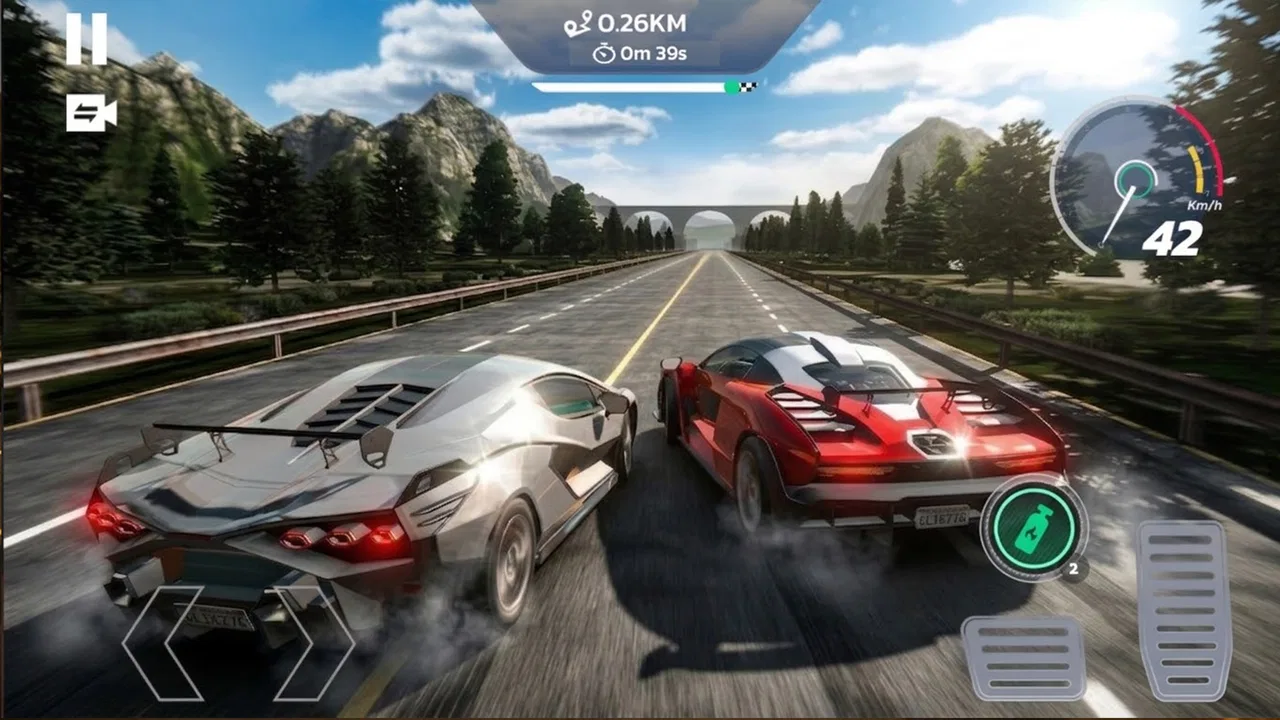
Traffic Car Racer: Driving 3D
- 4.5
- Rating
- 1.00M
- Installs
- Free
- Price

 Analysis by App-foxy
I spent time with Traffic Car Racer: Driving 3D as a quick, traffic-focused racing game, and my first impression was straightforward: it is built around the simple pleasure of threading a car through busy highway traffic while trying to stay composed. That focus makes it easy to understand within seconds, but it also means the game depends heavily on how much you enjoy repeating short driving challenges and improving your own control.
Meta Play Studio presents this as a free racing game for Android, with a general Everyone age rating. It has reached over a million installs and holds a 4.5 average from around 975 ratings, which suggests that the basic driving idea connects with a sizeable audience. I can see why: there is no complicated setup to learn before getting behind the wheel, and the realistic 3D driving physics give the central action more weight than a purely arcade-style traffic dodging game.
The current release is version 1.1.3, and the game runs on Android 7.0 or later. That makes it accessible to people using older compatible phones, although the visual presentation and driving response will still depend on the hardware. The game is free to start, with optional in-app items ranging from $0.99 to $19.99 per item, so I would approach it as a free trial of the driving loop rather than assuming every part of the experience is available without spending.
You May Also Like

 Blood Strike: 2.5 Anniversary
Blood Strike’s Loadouts Turn Every Drop Into a Tactical Gamble
A close look at Blood Strike’s custom loadouts: how fast access to signature weapons reshapes its battle royale rhythm, rewards preparation, and narrows the gap between fights.

 Pandora - Music & Podcasts
Pandora’s Music Is Easy to Start, but Harder to Recover
Pandora’s strength is its low-effort path from a seed to a station. Its weak spot is how much confidence it asks you to place in connection, setup, and quiet recovery.

 8 Ball Pool
 Is Built on Rivalries, Rematches, and Routine
A close look at the rivalries, rematches, shared routines, and unanswered safety questions that turn a quick pool match into a persistent mobile community.

 Samsung Music
’s Quiet Strength Is Playing What You Already Own
Its reach comes less from spectacle than from dependable access to a personal library. That simplicity is both the app’s strongest retention engine and its ceiling.

 AccuWeather: Weather Radar
AccuWeather Review: A Quick, Clear Forecast for Everyday Decisions
For everyday plans, the best forecast is the one you can understand quickly. AccuWeather makes rain timing, radar, and local conditions easy to act on, with a few trade-offs.

 Hill Climb Racing
Why Hill Climb Racing Still Turns Crashes Into One More Run
A tiny car, a bumpy hill and one more upgrade: Hill Climb Racing keeps resurfacing because its simple chaos makes every near-miss feel personal.
More From Our News Desk
View All News


How the current driving experience feels
I approach the driving as a sequence of small decisions rather than a race to force every opening. In this section, I’ll focus on how that habit shapes the moment-to-moment feel and why reading traffic early matters more than chasing a dramatic pass. That gives a useful baseline before considering what the current build means for someone deciding whether to start or return.
A focused highway challenge
The appeal here is not a large open world or a long story campaign. I found the game more enjoyable when treating each run as a compact concentration exercise: watch the gaps, judge the speed of nearby vehicles, and make small corrections instead of reacting dramatically at the last moment. That gives the highway a rhythm. A successful run is less about one spectacular maneuver and more about staying calm through a sequence of ordinary decisions.
The 3D presentation helps with that sense of space. Traffic is easier to read when cars have visible depth and position rather than appearing as flat obstacles. The physics also encourage a lighter touch on the controls. Overcorrecting can turn a safe-looking gap into a collision, so I recommend beginning with deliberate movements and learning how quickly the car responds before attempting close passes.
This is one of the first useful habits I would suggest to a new player: do not aim for the smallest possible gap immediately. Use the opening moments of a run to understand the traffic flow. Once you know whether your car feels responsive or slightly heavy on your device, you can gradually reduce the margin. That approach is more reliable than chasing distance or speed from the first second.
Why the simple format works
Traffic racing is a good fit for short sessions. I could imagine playing while waiting for an appointment, taking a brief break, or trying one more run before putting the phone away. There is no need to remember a complicated plot or rebuild a long strategy after a pause. The objective is immediate: drive well, avoid trouble, and see how far your control can take you.
That simplicity is also the main limitation. Players looking for licensed cars, deep tuning, structured championships, or a broad collection of tracks may find the experience narrow beside larger racing games. Those alternatives usually offer more long-term variety, while this one places its value in the directness of the highway challenge. I would choose it for quick driving practice, not as a replacement for a full racing simulator or a content-heavy console-style racer.
Controls, attention, and phone use
My best results came from treating the screen as a space for small, predictable inputs. Traffic games can tempt you into frantic swipes or sudden turns, especially when two vehicles appear close together. In this case, that usually makes the situation worse. I found it more useful to look farther ahead than the nearest car, identify the next likely opening, and position the vehicle early.
A second practical tip is to avoid playing in a distracted setting. The game may be easy to start, but the traffic pattern still demands continuous attention. It is not the kind of app I would recommend using while walking, commuting as a passenger on a winding road, or doing anything else that divides concentration. A quiet place and a few uninterrupted minutes make the driving feel much fairer.
The minimum Android requirement of 7.0 is friendly to older devices, but compatibility alone does not guarantee an identical experience. On a less powerful phone, a 3D racing game can feel less comfortable if the display is small or performance is inconsistent. I would test a short session before deciding whether extended play feels comfortable. The game’s accessible requirement is helpful, but the quality of your particular device still matters.
What the latest version means for players
I treat version numbers as a reference point, not a promise of a particular kind of change. Here, I’ll look at what players can reasonably take from the current release and how to judge it through everyday play, especially by noticing control consistency and readability on their own device. From there, it becomes easier to decide whether this focused format matches the player’s expectations.
Version 1.1.3 as the current reference point
Version 1.1.3 is the release I would use when judging the game today. It is important to separate that current version from assumptions about future updates. The release number shows where the product stands now, but it does not by itself promise a particular roadmap, new vehicles, or additional modes. I would therefore evaluate the game on the driving loop already available rather than downloading it in expectation of a specific upcoming feature.
For someone returning after an earlier installation, the sensible approach is to notice how the present build feels on the same phone: startup behavior, control response, visual smoothness, and whether the traffic remains readable during longer runs. Those are the details that affect daily enjoyment more than a version label alone. If you already liked the basic highway format, the current release gives you a clear reason to revisit it. If you wanted a much broader racing package, a small version change should not be treated as evidence that the game has become a different genre.
The developer’s role in the experience
Meta Play Studio has kept the identity of the game easy to understand. The name, category, and driving premise all point toward a focused traffic racer rather than an elaborate collection of unrelated activities. I appreciate that clarity because it helps set the right expectation before installation: you are choosing a game centered on highway driving, not a general car app with a token racing mode.
The strongest sign of the game’s current position is the combination of a large install base and a solid average rating. Those figures indicate that many players have found the core experience worthwhile, but they should not replace personal judgment. Ratings often reflect the first few minutes of a game, while your decision should also consider whether the repeated traffic format will keep you interested after the novelty of the 3D presentation fades.
How existing users may feel the difference
Existing players who enjoy improving through repetition are the most likely to benefit from staying with the current build. Small gains matter in this type of game: taking a cleaner line, reacting earlier, and avoiding unnecessary steering can make a run feel noticeably better even when the overall format remains familiar. I would not measure progress only by dramatic new content. In a focused racer, better consistency can be the main reward.
New users should give themselves a few attempts before deciding that the game is too difficult or too basic. The first run is mostly about learning the visual scale of the road and the timing of the controls. After that, the challenge becomes more readable. A useful personal rule is to change only one habit at a time: first improve lane awareness, then work on passing distance, and only afterward try to drive more aggressively. That makes mistakes easier to understand.
Players who previously preferred very forgiving arcade racers may need to adjust their expectations. The realistic physics angle suggests that careless movements are less reliable than controlled ones. Conversely, people who want a serious simulation may find the traffic-focused format too limited. The game sits between those extremes: more grounded than a weightless dodging toy, but not positioned as a complete professional driving simulator.
Where the free model fits
The free entry point is useful because it lets you judge the controls and pacing before committing money. I would recommend playing enough to answer one question honestly: do I enjoy the act of navigating traffic even when there is no new system to learn? If the answer is yes, optional purchases may feel like a way to support continued play or access extras. If the answer is no, spending will not fix the central mismatch.
The in-app purchase range, from $0.99 to $19.99 per item, is worth keeping in mind before tapping through any purchase screen. I would set a personal limit in advance, especially if the game is being used by a younger player. The Everyone rating makes it broadly suitable in age terms, but the presence of optional spending still calls for ordinary device and account awareness.
One trade-off of a free racing game is that the first download decision feels easy, while the longer-term value depends on how the optional items are presented and how much variety you personally need. I would not install it expecting every desirable car or progression element to be included automatically. Instead, treat the no-cost starting point as an opportunity to test whether the highway loop earns a place on your phone.
Who should play it and who should look elsewhere
My recommendation depends less on how much someone enjoys racing in general and more on whether they like repeating a narrow, traffic-centered challenge. I’ll distinguish the players who can get satisfying practice from brief runs from those who are likely to want a broader set of race goals. That comparison also helps clarify when a different racing style is the more sensible choice.
A good match for short, skill-based sessions
I would recommend this game to someone who likes quick racing attempts, traffic weaving, and the satisfaction of improving through better timing. It is especially suitable for players who enjoy games with a clear physical task rather than a long narrative. If you like watching a situation develop ahead of you and making measured decisions under pressure, the format has enough tension to keep a short break interesting.
A realistic everyday use case would be a ten-minute evening session after finishing other tasks. I would start with a relaxed run to settle into the controls, then use a second attempt to focus on one goal, such as leaving more room before changing position. That kind of deliberate practice makes the game feel less like random swerving and more like a small driving exercise. It also gives a natural stopping point when concentration begins to drop.
It can also work for families who want a straightforward racing title with an Everyone age rating. I would still explain the optional purchase system before handing the phone to a child, and I would encourage younger players to focus on safe, controlled driving rather than treating every gap as something to force. The age classification makes the game broadly approachable, but good play habits and spending boundaries remain useful.
When another racing game is the better choice
I would skip this one if your priority is a deep garage, detailed car customization, online competition, or a campaign with many distinct objectives. A larger racing alternative will usually be more satisfying when you want a sense of collection and long-term progression. Likewise, if you prefer relaxed driving with no collision pressure, a calmer exploration game would suit you better than a traffic-focused challenge.
It is also not my first recommendation for someone seeking demanding simulation controls. The realistic 3D physics add weight to the driving, but the game’s identity remains centered on avoiding traffic and maintaining a run. A dedicated simulator is a better choice if you want detailed vehicle setup, track discipline, or a broader range of driving conditions. Choosing this title makes most sense when the traffic itself is the feature you want.
Compared with the usual endless traffic racers, the advantage here is the attempt to make the car’s movement feel more substantial in a three-dimensional environment. The disadvantage is that a focused design can become repetitive sooner than a game built around multiple race types. I would choose this one over a cluttered alternative when I want immediate driving, but I would choose the broader game for a longer weekend session.
What I would watch during continued use
I judge continued play by whether each attempt teaches me something practical, such as when I looked too close ahead or corrected too late. This section considers how to tell productive repetition from routine, and how to keep sessions purposeful without inventing extra systems or goals. With that in mind, the closing verdict can focus on the game’s lasting fit rather than its first impression.
Replay value beyond the first sessions
The key question for me is whether the traffic challenge continues to feel meaningful after the initial learning period. A good sign is when I can identify why a run failed instead of blaming randomness: I entered a gap too late, looked too close ahead, or corrected too sharply. If most failures feel understandable, repetition has a purpose. If every attempt begins to feel identical, the narrow format may become the main obstacle.
I would also watch how well the game serves different moods. It is strongest when I want a compact test of attention. It is less convincing when I want discovery, a sense of place, or a major achievement to work toward. That distinction matters because a game can be enjoyable without becoming a permanent favorite. For me, this is the sort of title I would keep available for quick runs rather than rely on as my only racing game.
Practical expectations before downloading
Before installing, check that the phone uses Android 7.0 or later and leave enough attention for a game that depends on visual timing. I would begin without making a purchase, learn the controls, and decide whether the 3D traffic is readable on my display. If the car feels difficult to place, I would first try changing my playing posture and reducing movement size rather than assuming the game is impossible.
I would also remember that the game is free but includes optional purchases. That does not automatically make the experience poor, yet it changes how I would approach progression and spending. Set boundaries before a tempting moment in a run, particularly on a shared device. The best value comes when the basic driving already feels enjoyable without pressure to buy something.
My recommendation
Traffic Car Racer: Driving 3D is a focused, accessible racing game with a clear strength: it turns ordinary highway traffic into a test of patience, timing, and control. I like that it can be understood quickly, yet still rewards players who stop making rushed corrections and start reading the road ahead. The 3D physics give the simple premise more character than a flat obstacle course.
My recommendation is positive, with a specific condition: download it if you want short traffic-driving sessions and are comfortable with repetition. The free starting point makes that decision easy, while the current version gives returning users a sensible point of comparison. Just do not expect a full racing ecosystem. For a quick highway challenge from Meta Play Studio, it does its job well; for deep progression, broad content, or serious simulation, another racing game will be the better fit.
FAQs for Traffic Car Racer: Driving 3D
01What is Traffic Car Racer: Driving 3D?
Traffic Car Racer: Driving 3D is a mobile driving game focused on weaving through busy roads while controlling a car from a first-person or third-person perspective, depending on the available settings. The main challenge is to avoid collisions, maintain speed, and travel as far as possible. It is designed for short, casual sessions rather than a realistic full-scale driving simulator.
02How do you play Traffic Car Racer: Driving 3D?
Gameplay is generally based on steering through traffic, overtaking other vehicles, and reacting quickly as road conditions become more demanding. Players usually control acceleration, braking, and movement with on-screen buttons, tilt controls, or touch gestures, depending on the version and device. Success requires patience, accurate timing, and learning when it is safe to pass.
03Does Traffic Car Racer: Driving 3D work offline?
The core driving experience may be playable without a continuous internet connection, which makes the game suitable for commuting or areas with limited connectivity. However, certain features can depend on internet access, including advertisements, optional rewards, analytics, updates, or online-related content. It is best to launch the game once while connected and check which features remain available offline.
04Is Traffic Car Racer: Driving 3D free to download and play?
The game is typically offered as a free download, allowing users to install it without an initial purchase. Free access may be supported by advertisements, and some versions can include optional in-app purchases or extra content. Before downloading, review the store listing for the current pricing details, permissions, advertising policy, and any purchase options available on your Android or iOS device.
05Is Traffic Car Racer: Driving 3D suitable for children?
Traffic Car Racer: Driving 3D is generally simple to understand because its main controls and objective are straightforward. Nevertheless, parents should check the age rating and store description before installation, especially because free mobile games may display advertisements or offer in-app purchases. Younger players may also need supervision to prevent accidental purchases and to manage screen time during repeated driving sessions.
Pros
- Simple controls make it easy for beginners to start driving.
- Several camera views improve visibility during races.
- Short races are convenient for quick gaming sessions.
- Traffic-filled roads create constant challenges and variety.
- Runs smoothly on many older Android devices.]
- contras:[
- Frequent ads can interrupt gameplay and reduce immersion.
- Vehicle handling may feel too sensitive for some players.
- Progression becomes repetitive after extended play.
- Limited customization options reduce long-term appeal.
- Some tracks and cars require significant grinding to unlock.
Cons
- Frequent ads can interrupt gameplay and reduce immersion.
- Vehicle handling may feel too sensitive for some players.
- Progression becomes repetitive after extended play.
- Limited customization options reduce long-term appeal.
- Some tracks and cars require significant grinding to unlock.

Traffic Car Racer: Driving 3D
Gallery